Wednesday, 2 January 2013

Happy New Year - The Shape of Things to Come

A very happy new year to all of you!

Just to kick off as I mean to go on, I thought I'd get a post in early.

A small foretaste. My Pictish army will include a fairly large mounted element. I have managed to get ONE done (they stalled a bit in the face of other things), and here he is.

Keep up lads!

All the minis here are from Newline Design. The rider is a minor conversion, in that he had the spear arm re-positioned and a helm modeled with green stuff.

A roughly double move (depending on the era, the move is more or less) compared to infantry, and in the case of the AoA list, free of the problems of warband status, these men can race round the battlefield and wear down the slow, slogging Saxons, wild Norse or lumbering Sub-Romans!

Enjoy!


Sunday, 30 December 2012

Miniature Design Studio Pictish Miniatures

So I lied! I managed to finish something else before the year petered out.

I came across Miniature Design Studios a little while back, and after the exchange of a few e-mails with Dave at MDS, finally got round to buying some metal from him.

When I bought these figures, I ordered three "Unit Builder Packs", each of ten figures, one lot of archers, one lot of crossbowmen and a set of javelin-armed skirmishers. At my request, Dave very kindly put a mixture of the available poses of each figure type in each pack. Unfortunately, but for very sound reasons, Dave no longer offers this pack size.

The packs arrived two days after being ordered, well packaged and complete. Beat that for service! Size-wise, I think the figures fit very nicely with my "usual suspects" (Gripping Beast, Black Tree, Crusader, Newline, etc.), but are at the slim end of the spectrum rather than the epic proportions of, say, Renegade. Quick piccie here to let you draw your own conclusions. I am perfectly happy to mix any of these.

Left to right, Crusader, MDS, Newline, MDS, Black Tree, MDS, Gripping Beast

Castings are crisp and neat, in a hardish metal that responds better to scalpel and file than burnisher. Having examined all thirty figures, precisely ONE had any visible flash (and very little of it there). Mould lines were small and fine, and easy to remove. No evidence of pinholing or miscasting anywhere on any figure. The castings do have a number of tiny "pigtails" adhering to them, as seen on Perry castings. Look out for these - they aren't always easy to spot and do nothing for the final finish if you miss them!

Poses are nice, quite dynamic in most cases, and thoroughly believable. The anatomy is realistic, and as I said above, the figures are slim rather than bulky. Since they are intended to represent the lower echelons of a Dark Ages subsistence farming culture, I reckon this is no bad thing!

The javelinmen came in three poses, immediately generating a nice sense of variability among them. This was enhanced by the addition of a good selection of separate shields. Two different sizes / designs each of round and square shields, plus an iconic "H" shaped example mean there's no way this lot are going to look uniform! Helpfully, two of the poses actually have both hands moulded to hold a weapon which makes arming them with a number of javelins quicker and simpler. The javelins themselves are moulded separately, on small sprues as sets of three. A total of 12 are supplied, enough for a couple of the figures to carry two weapons each. I'll put my hands up and say I'm not a big fan of white metal spears / javelins. I prefer to make them up from brass or steel wire, but these ones are nice: they are in scale, with realistically sized heads and note they actually are javelins, not spears that need to be cut down and reshaped. Front and rear views of the three different poses.


Don't throw those bloody spears at me!

The archers come in five poses, two examples of each of which were delivered. The range here, loading, firing and kneeling, some in cloaks and some without, is fantastic. The bows are moulded on the long side, allowing you to cut them down if required by your views on Pictish archery techniques. These are strung with 8/0 flytying thread fixed with cyanoacrylate.

Speeding the arrows' deadly flight.

The crossbowmen are currently two poses only. Both wear cloaks and give the impression of being very sneaky! The crossbows are moulded separately, which I think is a nice touch. Additional poses are in the works and if they follow the lead of these two as the other figure types have, these should be very nice indeed.

Don't quarrel with a crossbowman - you'll lose!

None of the figures carries a secondary weapon. If you're bothered these can easily be added via a bit of greenstuff. I've done this with other minis I got but these are "as is" to show what MDS provide before I muck it up!

The MDS range is expanding all the time, and it's well worth checking in on the website and the Facebook page to keep abreast of things currently in the work. As I understand it, at the time of writing additional crossbowmen are in the works, along with spearmen in cloaks (the masters look brilliant), plus cavalry (yay!) and a chariot (not for me, thanks).

Dave has rationalised his prices, as I noted above. This is to provide some capital for the expansion I mentioned. I think it's worth  pointing out that even after this, these minis work out at precisely £1.10 each. This is still significantly cheaper than most of the other manufacturers I buy from. Given that many Dark Ages armies are figure-dense due to the relatively low points cost of the troops, this is an important consideration.

For the record I am kicking myself for not buying loads more figures before Dave changed his prices. However, I confidently predict he will be seeing a thick slice of my disposable income in 2013.

Recommended without reservation.

Lads! Lads, I've got a plan...

To quote Michael Caine.

This is probably going to be the last posting for 2012. I think its rather unlikely that I'm going to finish anything much before the new year.

However, I have plans for 2013. Here goes...

Finish the Pictish army (naturally, well, there's barely five minutes work there is there?)
AVOID building a Viking army!
Build a Sub-Roman army (this is predicated on Gripping Beast getting their plastic generic Dark Ages warriors out. Hint hint!)
Scratch up some earlier Saxons to make my Anglo-Saxon army more versatile.

And terrain... LOTS of terrain. I blame two books. Leslie Alcock's Arthur's Britain and the Warhammer Age of Arthur supplement.

Alcock's work is getting a little bit dated and the scholastic view is that there can in no way possibly have been such a person as King Arthur because of the tall, mismatched stories. But then, as Geoffrey Ashe put it "...as a warning to skeptics who argue that anyone credited with giant-killing and dragon-slaying must be fictitious, I would point out that (Davy) Crockett himself, a U.S. Congressman, became the hero of tall tales as far-fetched as any told of Arthur". So there!

Alcock's work and especially the ideas over warfare and the reconstruction of South Cadbury were just compelling. It hooked me and reeled me in!

 The AoA supplement is out of print and makes good prices second-hand on Ebay but is well worth it. The scenarios are quite broadly applicable - defence of a river crossing, attack on a retreating raiding force, siege of a decaying town, and are quite easily mutable to make the engagements bigger or smaller.

All of these require terrain. A dyke and a fortress wall. The dyke is a fairly simple construction. A deep ditch and an earth bank, with limited revetting, no obvious construction and without actual gates - just bits where there are no ditches. I need about four linear feet so I'll make it in sections, with the opening separate so it can go in anywhere along it.

The fortress wall, now this is a real project! Based on Alcock's various reconstructions, with the addition of corners, watch turrets and gateways! Again, I'll make this in sections to allow it to sit at various points on the board. I see about three linear feet of wall, in various lengths, plus the bits and pieces.

Luckily, I had a real find not long before Christmas. Feet and feet of pieces of the waste poly foam I use, in bits about six inches square! What more could I need?


Saturday, 24 November 2012

Children of the Circle

Picts, preparing to make somebody's life very, very unpleasant.


Pencils on black pastel paper.

Enjoy!

Sunday, 18 November 2012

Anglo-Saxon Army for WAB


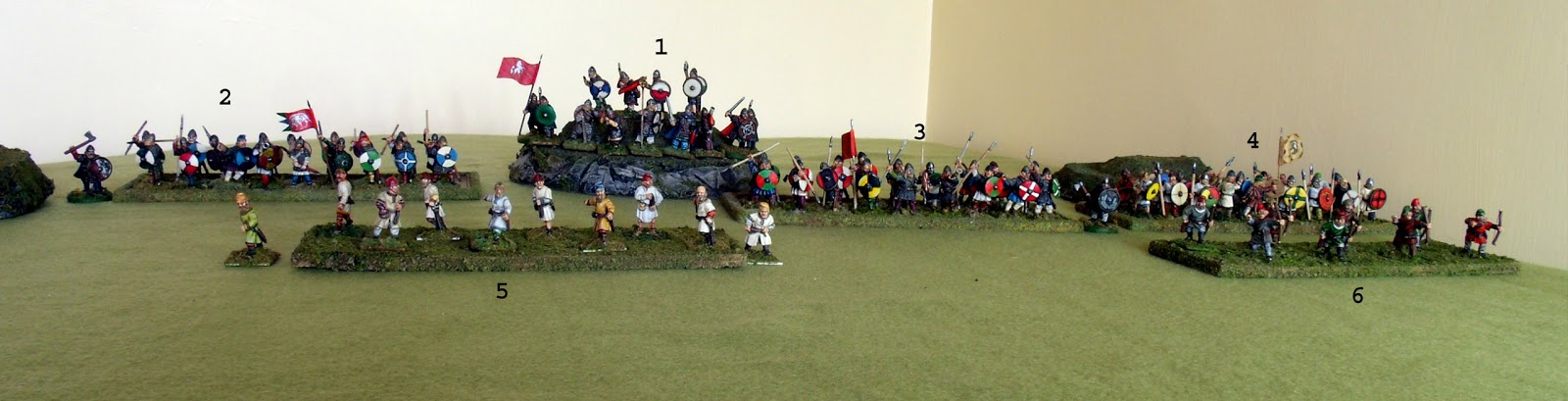
Well, here’s my Anglo-Saxon army. Really, it’s Anglo-Danish, due to the presence of huscarls, but a bit of jiggery pokery and mixing these figures in among the thegns would make it suitable for earlier periods too.


Anytime you feel like it...

We have the army general, a Jarl, plus one of the three Aeoldermen, designated the army standard bearer. These are drawn up with the single unit of huscarls, equipped with two-handed axes, with leader, musician and standard bearer. Here right in the centre on the highest ground they can dominate the battlefield (1).


Then, two units of armoured thegns (2 and 3), each unit having a leader, musician and standard bearer. One each of the other two Aeoldermen is attached to these units, to bolster their leadership.

A single unit of ceorls (4), with leader, musician and standard bearer provides some support for the flanks and acts as a reserve, albeit not a terribly mobile one.

Finally, two units of geburs (5 and 6), one armed with slings and one equipped with bows round out the army with some fire support.


The strengths of this army are the large number of steady, well-armoured infantry that can fight in strong formations (using shieldwall) with spears. This is amplified if you have huscarls in the army.
The mixed unit rule, whereby you can intermix armoured and unarmoured troops and have them fight as the former, makes even relatively cheap troops noticeably more formidable.
Its weaknesses are its relatively low mobility and a dearth of missile troops. The latter can be solved, by swapping a fairly small number of thegns for a much larger quantity of sling armed geburs, but the mobility problem remains.

By varying the banners, and hence the origin of the army, you can make some changes that have quite an impact on how the army performs.

Fighting under the golden wyvern of Wessex, all the thegns gain veteran status, and a chance to re-roll a single attack per unit. In my case this might make the difference between winning and losing two rounds of combat, and that might make a difference between winning and losing the whole battle.

The eagle and saltire of Mercia allows thegns to be designated as light infantry. In skirmish formation, the double rate move does go some way to overcoming the mobility problem. A Mercian army has a chance to actually seize and hold an objective in the face of a more mobile army, rather than to simply wait until the enemy in place and have to dislodge them.

Under the Invicta, Kentish men (or men of Kent) as shown here, were famed for their aggression . Thegns and ceorls can swap thrusting spears for throwing spears. Thus a charging unit can attack in two ranks in the first round. Two ranks, probably striking first and the gain of momentum is a potential battle winner.

Generally, this is not the army that can dash across the table to secure the strategic terrain or seize a key structure. It doesn’t dash anywhere, but tends to trundle very deliberately. However, anything attempting to interfere with that trundling had better be numerous, resolute and prepared to be crushed flat by a spear-tipped steamroller. Likewise, if it gets itself set somewhere it wants to be, then driving it off is no easy task.  With its light troops guarding its flanks and buying time to re-orient the heavy units, trying to outmanoeuvre this army might not be as effective as you might think. If the characters can hold the units together, and provided I don't roll too many 1's so the warbands charge like maniacs, it's a winner.

This is the army that ground Harald Hardrada and Tostig Godwinson into the earth at Stamford Bridge, and came within an ace of sending the Bastard of Normandy back whence he came.

Come on have a go, if you think you’re hard enough!

Thursday, 8 November 2012

Saxon Great Hall, Part 3


The final part of the saga! You could be forgiven for thinking that there was an enormous amount of work went into this, based on the time it's taken to write. In fact the building, painting and whatnot was fairly quick,compared to the problems involved with supplies, computers and cameras!

Anyway, first thing was a layer of flock outside, muted down a bit with a burnt umber wash. 

Painting followed the usual scheme - lots of drybrushing in progressively lighter shades. I think it worked well enough.

A large chair (for the thegn) was put on a low dais at the doorless end, where the master and mistress of the hall would have sat. This were plastic card, scrap balsa and a bit of greenstuff. The rushes on the floor are sisal string held down with PVA. A wash of burnt umber followed by a drybrush of a light, dusty colour ties these in. You could add tapestries, and all sorts of other decorations but I limited myself to a shield on the wall for colour.

 Best seat in the house.

I added opened shutters on the windows, plus two doors closed, and one open. I felt it was easier to add these later on, to avoid them breaking off during construction. 

Not exactly double-glazing...

The final touch was some decorated panels over the lintels of the doors. These can be very colourful and decorative, making a nice accent. I drew these out, about four times the final size then shrunk them to fit on the computer.

How decorative!

Here it is, finished. Not perhaps the dwelling of royalty or even an eorlderman, but a building belonging to a successful thegn, and step up from the Anglo-Saxon equivalent of a used car salesman!


Who lives in a house like this?

Enjoy!

Some Limited Conversions

I needed some command figures for the second set of thegns I have as part of the Anglo-Saxon army. I had a few spare figures from Gripping Beast left over. These were ordinary spearmen, but a little work with wire and green stuff turned them into a standard bearer and horn blower.

First up the standard bearer. Here he is, with a shot of the original figure (another example obviously), for comparison.   First job was cut away the original forearm, and make a slot in the shoulder to allow the upper arm to move into its new position. A hole drilled into the upper arm to take a piece of soft wire allows the new upper arm to be formed. I put the banner staff in place at this stage, attached to the end of the wire armature. I found that this allowed me to model the hand in situ more easily and accurately. After I was happy with the hand, I modelled the tunic sleeve, then made good the cuts and bends on the mail shirt.


The staff is a piece of steel rod with a point hammered and ground. The banner is the one I posted here, if you remember. Glued down onto a pit of paint tube and bent to shape, I think it looks the part.

The hornblower is slightly simpler. A cut or two around the joints of the arm, a couple of bends and some modelling of the hand and the horn from green stuff. The starting figure again is pictured with the conversion for comparative purposes.


I know that they're pretty minor conversions, as far as these things can go, but they're just the thing to do the job I want doing.

Enjoy!